Defense

photo-1439846583999-b988afee1b0a

Filter for your thoughts? Filter for your mouth?

More important than a filter for your effluence is a wall in your brain. You need defense from the influence. You need something like a magnificent castle wall: something to help you be able to keep the fool ideas out.

It’s tough. There are so many, and they don’t come at you in single form, they come at you by the hundreds. Hundreds in a day will pass by your eyes, bomb blast your ears, infiltrate your brain, and contaminate your mind.

But they’ll only affect you if you let them, so keep your defenses up. They’ll attack you at every moment, especially when you have your guard down.

So the obvious question is, “How do I get a fancy defensive wall in my brain?”

Easy! Send cash to the address on your screen!

No, not really. I’m just messing with you.

There are ways to set up defense. Most of it has to do with being determined. Developing determination is done with pre-determination: Decide now, before the subject comes up. Sounds easy, right? Not super easy, because life is complex. There are so many subjects you might need to be determined about that you probably can’t decide on everything. A good general determination couldn’t hurt though.

For the sake of example, let’s say you’re interested in being healthy. Your ambition to stay healthy can be pronounced inside your head, “I refuse to do anything that will screw with my physical prowess.”

To make your determination more substantial, after you say, “I refuse to do anything that will screw with my physical prowess,” flex your biceps. It really works. It works even better if someone is watching. Truth!

Despite my funning on the subject of health, just think about it. If you had that determination not to “screw with” your “physical prowess,” could you be influenced to take up smoking? Not likely. Could anyone convince you to eat a boatload of junk food? Again, not likely. So there are two things you’re predetermined not to do, just from that one determined sentence. In fact, would you eventually start to understand that your physical prowess was dependent on exercise? Probably. You wouldn’t just be against things that would destroy your health, but you would be actively engaged in the promotion of health.

Not that I meant to go there in the first place, but it looks to me like a good defense enables a good offense. Whad’ya know?
T-E-Z-L-A

nightlight

Call me gullible, I bought a new Tesla, only the name was spelled T-E-Z-L-A.

The first thing I noticed was the signal light. I wanted to change lanes so I flipped the lever for the signal and the whole dashboard dimmed out. It was a lot like when you’re in your house during a rain storm and the lights flicker almost all the way off but not quite. There’s that moment of pause, no matter what you’re doing, when you look at the nearest light to you and for that split moment wonder, “Is the power going out?” Then the lights come back on and your brain decides, “Nope.”

I went through that whole routine, except I did it while driving. As soon as I was in the other lane, I flipped the blinker off and the dash lights came back on, so the whole thing lasted maybe a second. No big deal, I figured.

I was wrong.

The next time I noticed trouble with that fancy new electric car was when I tried to run the radio. Oh, the radio worked fine, but while it was turned on the car wouldn’t—couldn’t—go over 40 miles per hour. Like any smart monkey, I didn’t turn the radio off, I just smashed the pedal down to the floor harder. For some reason, pressing harder didn’t actually make the car go faster.

During the same trip, while I was getting yelled at by other drivers for going only 40 on the highway, I tried to signal a lane change with the radio on and the go pedal pressed down to the floor as hard as possible. The battery-level readout blinked off quickly and came back with the words: Never Surrender.

I’m still not sure if that was a message for me, or if the car was declaring its determination.

Either way, I decided then and there to give the car back to the dealership. When I got to a safe place, I pulled off the road and made some phone calls. These were unhappy customer complaint type phone calls. It ate up a lot of my precious time, but I finally got someone in the company to take me seriously. They agreed to check the car for defects with one condition: I had to bring it to them.

It was almost night. This was going to be a problem.

What I did next was neither safe or sane. I turned off every peripheral electronic function of the electric car so it wouldn’t waste energy. Then I threw out some of the dead weight as if I was in a ship on the ocean, sinking. I threw out the cup holders and the carpeting, the ashtray and the airbags, the rearview mirror and the back seat. There were big empty spaces everywhere when I was done. Once I was convinced everything unnecessary was out of the vehicle, I drove like a nitro racer back to the dealership.

Driving at night with the lights off and no radio, I got back there in under 5 minutes. I won’t tell you how fast I was going. I knew the car would never go that fast if the lights were lit.

It doesn’t need to be said, but I’ll say it anyway: I left that car there and I never went back.


The Art of The Non-Apology

photo-1541170075831-3efb46304814

I’ve been trying to develop the art of the non-apology.

Let me know if any of these works for you. They’re some that I’ve been polishing, so it helps to know if they’re effective at all.

“I need to give you my apologies. I’m sorry I’ve been subversive lately, but your timid passivity brings out the negative aspects of my character.”

“I’m sorry I’ve been cranky lately. It happens when I work too much and miss lunch.”

“Sorry we crushed your house. You never know when you’re building where the warpath is going to be.”

The non-apology is the best tool for when you don’t want to admit fault, but you don’t want to directly pass the blame either. It’s a passive-aggressive technic, for sure.

It’s a great writing tool as well, because the reader can detect the inequality, and they start to develop a liking for one character and a dislike for another without knowing for sure why they like one over another. It’s subtle implication at its best.


Ambassadors of Mountain Biking

I like writing. But I really love mountain biking.

So my two favorite things to do are words that sound the same. Writing. Riding. If there’s no context, in the spoken word, you might get those two mixed up.

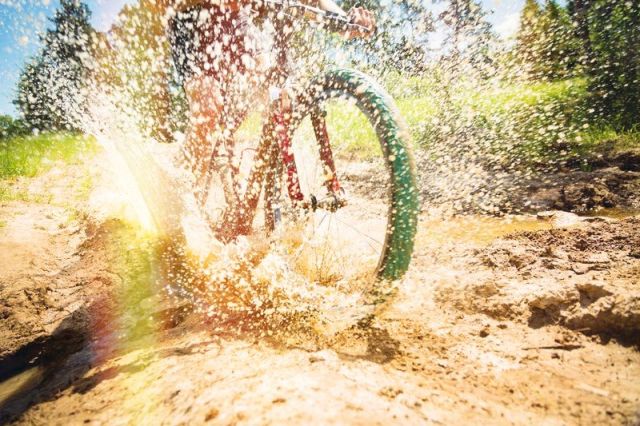
My most recent ride took me up Rock-A-Billy and down Ridge Line. These are just trail names, so they’re meaningless to you unless I show you a picture…

photo-1492500318351-274a118407c2

…or two.

photo-1532117892888-38948e152b3a

While I ride, I’m always meditating on something. I was considering the sport of mountain biking. It has exploded in popularity lately. I’m not sure why it has exploded, but I considered a comparison. Is this what it was like in the 1960s when surfing was hugely popular? I’ve heard it said that the beaches in California were so crowded with surfers that you couldn’t spit in any direction without hitting one of them. The ocean itself was so crowded, people actually got in fights in the water over “stolen” waves. Trying to figure that out in my mind, I honestly can’t imagine how you would make lines in the ocean so everyone would get a fair turn.

In mountain biking it’s easy: people going up the hill have the right of way, ’cause it’s a tough job going up. People going down pull over and let the riders going up have the trail. Once the mountain goat herd has passed, the trail is yours again. On the way down, if you meet someone slower than you, it’s a simple trick to say, “Passing on your left,” or “Passing on your right.” This way the rider ahead of you knows to stay where they are and where you’ll be when you pass. Actually, I never say, “Passing”; I only say, “On your left,” or “right,” whichever side I’m on.

I guess, “Passing on your left,” is the formal way to say it. Kind of like adding “sir” or “ma’am” after “yes”.

mntnsplash

“Yes sir.” I learned something about myself: I’m an informal rider.

I think next time I go, I’ll try a new phrase. Something like: “Hello sir (or ma’am), I’ll be passing on your extreme left (or right), if you don’t mind.” And then after I’m ahead, I’ll turn and say, “Have yourself a wonderful day, my new friend!” That’ll get their attention.

One other unspoken rule is to leave no trash up there on the mountain. We respect the trail and leave it clean. Just like surfers are the best advocates for a clean ocean, mountain bikers are ambassadors of their sport. Mountain bikers keep the mountain clean. I’ve seen dudes having an ice cold beer on the tailgate of their truck after a long ride. They could have thrown beer bottles against the rocks. They could have broken the bottles and left glass everywhere, but the mountain isn’t a bowling alley parking lot, or a concert venue, or a wedding reception center. They packed the bottles out with them. Good form, gentlemen! Good form.

Prejudice

photo-1553453005-3bbd7272e18f

If our first response is a reaction, it’s usually wrong.

When we choose not to react and take time to investigate what is causing us to react, we can usually learn a lot.

I spent a day in a venue with a group of people I definitely wouldn’t normally be around. They were “vape-o-sucks,” which is my pet peeve name for anyone who sucks on a “douche-flute,” which is my pet peeve name for a vapor administration device. They were actually alright. The people, I mean. I only had to tell a few of them to blow it away from me. Most of them realized, without me telling them, that I wasn’t hip to the vapors coming my way. One guy would turn his head and blow the mist away from me, without me mentioning it. Another guy would move away to take his puff of fruity smelling vapors, and then he would come back when it was mostly gone. Kind of reminded me of someone trying to be polite with their farts.

A lot of the people I talked to were friendly and genuine. With some, I even actually no kidding had stuff in common.

The place was outside, so I tried to stay upwind as much as possible. I could still smell a lot of it swirling around the venue. There’s no question that I inhaled an unfair amount of the junk. Some of it smelled like raspberries, while other vapors smelled like maple syrup. Personally, I don’t understand the need to scent it. Why not just let it smell like petrol? Or tanned leather? Or aluminum shavings?

vapeosucks

The point here is not that I’m going to sue everyone at the venue for infecting me with secondhand vape. I’m not. The point is that I met a lot of the people who did that junk, and even though I still have no respect for the habit, the addiction, or the culture of “vape-o-sucks,” now that I’ve met someone who does it, I can see more clearly through the haze. These are regular people. They’re normal chumps just like you and me. Their gullibility is just more noticeable. It forms a fruit-flavored cloud around their heads.

Because of my discovery, I think I’ll treat people more kindly, regardless of their choice of chump.

Though I’m probably a better human for hanging with the vape-ohs and not hating, I’ve decided not to ever do that again. The next day when I woke up, I swear I could smell nitrous oxide. At least half the day I thought I should be laughing, but no laughs came. When the smell of nitrous finally wore off, I thought I could smell things normally again, but I ate some yogurt—it smelled like nachos.

shock