Guest column—Ask Suzi Uzi

suziuzi

Dear Suzi,

My gluten-free gluteus has a junction malfunction. The breeze is cold. I don’t chemical treat. Is there a natural way to fix it?

Naturally,

Jean Lowe


Dear Mister Lowe,

Jean,

Are you aware nature is full of chemicals? In fact, that’s where we get all of our chemicals—nature. Don’t hurt your puny head with this little fact, but your body, including your gluteus, is composed of chemicals. It’s not the chemicals you need to worry about, it’s the reaction when you combine them. As for your junction, let’s assume…wait, maybe that’s the wrong word…let’s guess your problem is internal. If so, you might want to change your diet. If my first guess was wrong, your problem is external, and the fix is as easy as pulling up your pants.

Seriously,

Suzi Uzi, PhD


Dear Suzi,

I have a friend who uses chestnuts all the time. He won’t stop. He’s driving me crazy. Make him stop. Pleeeease!

Insanely yours,

French Fried Friend


Dear French,

You almost had me there. I was going to reply with some real advice column stuff. Only after I started to agree with you that chestnuts, cliches, maxims, and trite phrases are the bane of all mankind’s existence, did I realize you were talking about yourself. After I realized it, my advice changed. First of all, talking about yourself as if you weren’t in earshot is a quick step toward split personality disorder. Second, talking about yourself in that way is dishonest. Be honest with your own self first. Your friends, real friends, will notice and come around more often. Then you won’t need those imaginary friends.

Cordially,

Suzi Uzi, PhD


Dear Suzi,

There’s a couple of people in this world with the same name as me. Should I change my name to be different? Or should I contact all the others and have them change their names? I kinda like my name, so it’s like, you know? There’s also this girl I like, but she has the same name as a girl I don’t like. Should I tell her? Do you think she’d change her name if I asked her to? Do you think she’d be okay if I changed my name? Would she even recognize me if I did?

Sincerely,

Anonymous


Dear Anonymous,

You have tons of mental issues. I don’t think we can fix you with advice over the infonet. You need an extensive psychoanalysis, hypnotherapy, and possibly more direct treatment such as encephaloelectroinjectiontherapy. Please call the office and set up an appointment.

Yours,

Suzi Uzi, PhD

Jeep Safari/Rebelle Rally

photo-1507242207323-a3ca53b80849

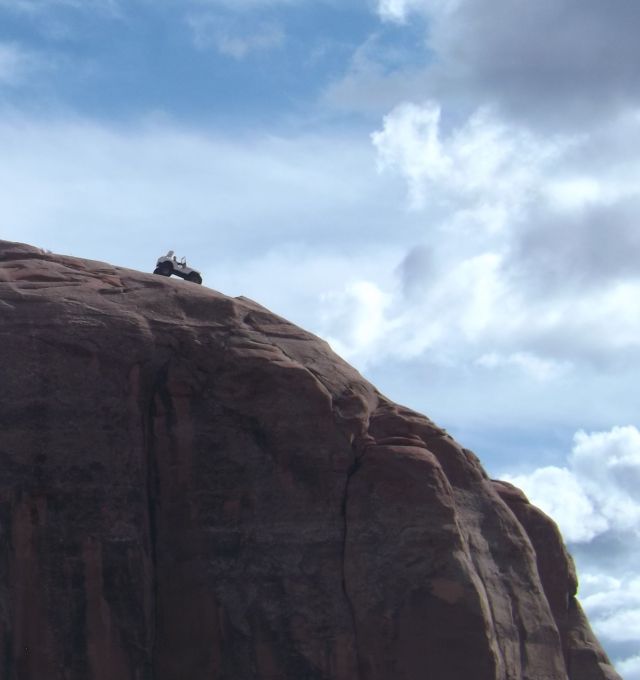
As fun as it is sitting in an office typing up words to thrill and entertain others, there comes a time to go outside. That time is Spring. A person has a limited threshold for sitting and meditating on word structure, sentence composition, and grammar usage for the grammar impaired. At times it benefits a person, like you and me, to get out and meditate on trail structure, degree of articulation, and lift height. I’m talking about Jeep Safari.

Easter Jeep Safari, in Moab Utah, is hosted by Red Rock 4-Wheelers, and it really is a huge event for those who enjoy a little off road adventure. Some people participate by renting a Jeep from one of the adventure companies in Moab, such as Barlow Adventures. Others who participate bring their own tricked-out vehicles. Though the majority of the people who play on the Moab rocks are driving Jeeps, it isn’t so exclusive that you can’t bring a Taco or a Raptor. It just has to be a street legal four wheel drive vehicle (they don’t allow UTVs or ATVs).

Machine against Earth, the Easter Jeep Safari has long been a challenge. It requires some technical driving skills and some knowledge of mechanical limits. The Jeep Safari has been going on for a long time, since 1967. And there’s one guy who’s been to all of them—with the same Jeep! Okay, I totally made up that last line. It could happen though.

Easter Jeep Safari isn’t the only game around. There’s another amazing event that has only been going for a few years (since 2016), but is fun to track. It’s an all female rally called Rebelle Rally. When I first heard about it, I thought, “Rebelle? Is that a French word?” Nope. Turns out the woman who started the event, Emily Miller, wanted the rally to have a cool name, so she mixed the words rebel and belle to make Rebelle. It works for me.

Rebelle Rally

Even though this one doesn’t happen until October, it’s worth the wait.

The Rebelle Rally operates differently from other races like it. In the Rebelle, competitors are required to locate checkpoints without a GPS. The closer they get to the true checkpoint location, the more points their team scores. Competitors are challenged to meet each checkpoint at a certain time as well, so it really is more of a rally than a race. Sometimes they’re required to keep to an average speed instead of racing from point to point.

A rally like this requires a wide range of skills: strategy, navigation, driving, and even problem-solving. The inevitable mechanical problem is a hurdle. So are the dunes. During one of the previous competitions, one of the teams lightened their vehicle by throwing out hundreds of pounds of equipment. I would honestly be afraid to do that. I mean, how are you going to do if you’ve thrown away your spare tire? But then again, throwing out the weight is a strategy for getting over the sand in the California-Nevada desert.

Anyway, Spring is coming up for the Northern Hemisphere, and since that’s where I live, I’ve been thinking about all the fun things to do outside. The two events listed above are only a small portion.

Get out and explore.

Writing Advice—Critical Hardness

tiredcat

There’s a part of writing that’s generously difficult—giving and taking criticism.

It can be very difficult to give criticism. You have to employ tact. Unless you’re slightly sociopathic, you want to employ tact. You have to employ specifics, and that without going over the top with your criticism. You don’t want to break the writer. When you’re giving writing advice, you want to enhance the writer’s will to achieve, not enhance their introversion. A writer, given the wrong kind of criticism, will curl up inside themselves and stop interacting with the outside world. This might be a stereotype, but all the writers I know agree. They all say they’ve felt the desire to be a hermit at one time or another.

A scathing piece of criticism rarely puts someone in the mood to follow any advice given with it. Usually this method works in the opposite direction. If a writer hears some rotten insult, they don’t agree with it, they defend themselves. They fight back. If they’re too intimidated by the criticism, or the critic, they might become withdrawn.

So “HOW?” is the great question. How do we give writing advice without being a Darth Vader about it? Instead of threatening people with telekinetic strangle-holds, we can learn some things to say that prevent the bad feelings and promote the correction. Of course the best way to correct someone is by looking directly at their writing. Then you can see a specific instance, such as a typo or a grammar flaw, not all of them, just one instance, and point it out.

There are times when that’s not possible. At times the criticism has to be general because you can’t immediately see the work. In those cases, it’s best to let the writer hunt down the specifics for themselves. Encourage them to find typos by reading the work out loud to themselves (or, if they’re brave enough, to someone else). Encourage the writer to look at specific parts of grammar (noun, verb, adverb, adjective, conjunction, preposition) and make sure those words are doing their job properly. If not, then the writer needs to place the words in the right spot so all the words work together. Encourage the writer to make sure there’s variety in their writing. Too much of anything can make the writing piece dull. You can’t have action all the time or people get desensitized by it—and desensitized to it. Dialog has to be interrupted at times. Adjectives can’t come in all-consuming waves. Variety has been compared with a spice. That’s a cooking metaphor. Chances are, you wouldn’t cook something to eat with only one ingredient. A meal, a dish, an entree, is certain to be better with some variety.

On the flip side, a writer needs to be able to receive criticism. Is that tougher than giving? Not if you’re me. I give myself criticism. I think it’s a valuable tool though. If I didn’t criticize my own work, I wouldn’t get better. Anyone who’s done it long enough can go read some of their earlier work. Only the oblivious wouldn’t see where the writing is weak, and where it has improved, and where the new stuff could improve. A benefit from that too, is the ability to receive criticism from others. You start to see where a piece of writing can be improved, but you also see how any scrutiny is worth hearing, worth having, and worth investigating.

I once got some criticism from an editor. He pointed out how many times I used certain words, how often I used the main character’s name, how often I used dialog interrupts. One time he pointed out where I managed to construct a passive sentence. I replied, “The passive sentence was written by me.” He verbally patted me on the head and pronounced me fit for public places.

“Good boy. Go play outside.”

Don’t get me wrong. Accolades are nice. Kudos feel better than chides, corrections, and slashes on our work. Adulations, however, don’t promote progress. The problems have to be recognized before they can be fixed, and you can’t fix a problem unless you can recognize it. If you’re too married to your own work, it can be difficult to see the mistakes. When that happens, an objective point of view is absolutely necessary. But that leads us into another topic with another question: How should a writer pick a proof-reader or a beta reader? I’ll detail some thoughts on that some other time. For now, remember criticism is difficult. It’s also totally, one hundred percent necessary.

Questions for Friends

babymanface

Questions to get to know your friends:

What’s your favorite color? What’s your favorite movie? What’s your favorite food? What do you plan on doing after you graduate from high school? What did you do right after graduation? How many children do you want to have when you get married and be a suburban clone? How many miles do you drive to work and back home each day? Do you ever ride a bicycle? Do you ever take mass transit?

Questions to scare your friends:

When was the first time you saw porn? What did you do when you saw it? How many people in your family have died? Were you involved? Have you ever witnessed a death? How do you feel about it? How do you feel about your mother? What’s your deepest, darkest secret? If you had to psychoanalyze yourself, what would you say your greatest mental obstacle is? Have you ever prayed? Do you know what repentance is? Have you ever done that? Can you do math? Want to buy my book?

Daylight Saving Time Fools Pranks

photo-1533749047139-189de3cf06d3

1. Find someone who speaks a foreign language: French, Urdu, Japanese, whatever. Tell your pet DST Fool that you suspect shifting clocks has put you in a different time zone. Have the foreign language speaker call them on the phone several times during the day. Sit back and watch your Fool get super confused.

2. With the kind of salt and pepper shakers with the screw-on caps, take the salt shaker and remove the cap. Get a napkin. Get some clear tape. Place the napkin across the open top of the salt shaker. Place a piece of clear tape over the holes in the cap of the shaker. Fill the cap of the shaker with pepper. Carefully tip the cap back on the shaker over the napkin and screw it back on. Some parts of the napkin should poke out from beneath. Tear it off until it’s no longer visible. With the shaker upright, remove the clear tape. When the DST Fool tries to get salt, they’ll get pepper.

3. Change all the clocks in your house or place of business to different times. Ten minutes fast. Ten minutes slow. Eighteen minutes ahead of the time in Hong Kong. Forty two minutes ahead of the time in Cork. DST Fools have an obsessive-compulsive need to adjust clocks. It will drive them crazy trying to synchronize all the clocks near them.

4. Get some raisins. Get a magazine and roll it up. Palm a raisin. Go up to a DST Fool and slap the magazine down on a table or counter or desk near them and pretend you’ve swatted a fly. Pick up the “fly” (the raisin from your hand) and eat it.

5. Get some POP-ITS brand fireworks. Any mild fireworks that make noise when crushed will work, but POP-ITS are best. Place them where the toilet seat comes down. Gently lower the seat on top of the POP-ITS. When your victim sits down they’ll hear a Pop! You’ll laugh. They’ll laugh. It’s all in good fun.

6. If they drink coffee, switch their caffeinated grounds with decaf, or their decaf with caffeinated grounds. They’ll love you for this one, either way.

7. Get your hands on one of those one-million-lumen searchlights. Set it up outside your DST Fool’s bedroom window and aim it in. Find out what time they’ve set their alarm to wake them in the morning. Turn on the searchlight one hour before their wake-up time. Brilliant!