
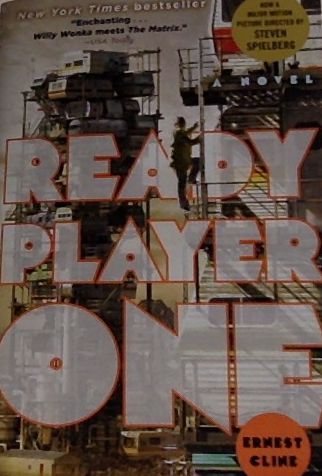
It’s got some good plot points. It’s fun to read. It has a few moments where I thought, “Yeah! That’s cool!” There were moments too where I couldn’t see how the excessive writing made any necessary addition to the story. Filler, I guess. Do all books have that? Stuff that gets in there that has nothing to do with the story, pointless fluff, or word-padding? It seemed like there was a fair amount of that in this book. And I haven’t seen the movie yet. I can’t say if the movie was a good representation.
One thing that makes this book stand out from others is that the ending has a good, well-thought-out climax. Have you ever read one of those stories where the main character gets the problem solved too easily? I felt like this one didn’t have that, and it’s all the better for it. I don’t want to read anything in which the solutions are fast and simple. Complicated is better. And although there were some moments within the climax that were definitely simple solutions, the overall feeling of the main character coming off as conqueror was satisfactory.
Ready Player One has one enormous thing in common with my novel Sound Distortion:
Pop-culture references.
While Sound Distortion focuses on musicians and musical references, Ready Player One deals with video game culture. I couldn’t help making comparisons. The main character in Sound Distortion, Djonny Desoto, is an inventor and a deejay. The main character in Ready Player One, Wade Watts, is an inventor and a video game fanatic. The side characters in Ready Player One are mostly new friends and acquaintances of the main character. The side characters in Sound Distortion are long-time friends. The bad-guy in Ready Player One is a super-rich, super-villain, Sorrento (I actually respected the bad guy, because he was written so well; Ernest Cline did a great job at defining his antagonist for this book). The bad-guy in Sound Distortion is just another kid, a student at the same school as the main character, and a persuasive psycho. With all of these similarities, there’s no question why B&N.com lists them both as, “People who like this also bought…”
In Ready Player One, I was thrilled with some of the video game references, bored with others. There are also some movie, cartoon, toy, and television show references, so that at times reading this book feels like a Simpsons episode.
In Ready Player One, I was a little disappointed at the idea of Wade Watts living in a cargo van, especially when I read the description of everything that was supposedly in there with him. I honestly don’t think all of that would fit in a cargo van. Unfortunately, I don’t have a cargo van to experiment on. Anyway, you have to read the book to know what I mean.
My overall impression was good. I could recommend this book. But you can’t read it if your naive and impressionable. You don’t have to have a vast knowledge of pop-culture trivia. You do have to have a firm grasp on reality. If you don’t, then I would probably recommend something else like: How To Lead A Life Of Crime by Kirsten Miller. Ha! So there!
 One aspect of writing is that you don’t have any excuses to take a day off. It’s not like being a carpenter. When you’re sick, you can still write. To claim a sick day as a writer, you’d have to go blind, AND lose your voice, AND lose the use of your hands in this technological age. Voice recognition technology is getting better and better—and it’s getting good enough that it can get most of your words right. You can record notes, dictate essays, or even waste time sending voice-to-text messages, if you have the right device with the right program. Not to distract you with that, but can you imagine actually needing to send voice-to-text messages? It seems a bit excessive or superfluous to me. I’m sure there’s a use for it. Maybe you don’t type so well. Maybe you need your hands for other operations. It could be convenient to have a hands-free method of sending messages. But then there has to be a limitation on the other end too, such as the person on the other end has to be unavailable or unable to hear your voice message. I mean, why would they need a text-based message versus a voice-based message if you can give them a voice message? Anyway, I’ll let that one rest now. As a writer, you can’t just use the “I’m not feeling well” excuse like many jobs. I mean, you’d really have to be incapacitated to not be able to screw a few word-planks together.
 If you owned a business, what would you name it?

 Xenosthesia.com