Never have I seen Bigfoot flying in a UFO, but it makes sense that he would.
How else would he avoid being spotted by the majority of humans living on the planet?
“The majority of humans” also happen to be the majority of animal life on land. Oh, hold on now. Of course, that could be a possibility too…
Maybe Bigfoot has himself a submarine to keep himself away from humans. I mean, mankind is in the ocean a fair amount, though not nearly as populace as on land. Hmmm.
One problem with this idea is that the Sasquatch, the Yeti, these are legends originating from inland peoples. Far inland. So far from anywhere the big guy might want to park his submarine, he would be a long time traveling on foot to get back to it.
Then again, this is BIGfoot we’re talking about, so maybe he has a longer stride than most would imagine.
The next question would have to deal with how he obtained said submarine. Could he be an engineer and a mechanic, as well as an avid hiker? Did he borrow the sub from someone? Did he make his own? Does he also have a year’s supply of canned ham on board? I’ve heard that’s traditional sub food. Does he have SCUBA gear too?
These are the things I’m going to ask him when I meet him.
The title brings to mind a royal dude who wants fewer people in his kingdom.
That’s not what I’m on about today. What is throwing itself against the walls of my mind right now is a whole lot of everything. Subjects don’t seem to want to line up single file, or take turns talking. It’s all a riotous noise-fest. One item of attention comes to the foreground and immediately another crowds it out. The only way to focus at all is to step out of the chaos and view it from above.
Like an astronaut who just left the planet and is viewing it all in macrocosmic splendor.
But then, of course, you realize there’s more out there. More planets, more galaxies, more suns. More human brains operating the same way.
There’s even more if you start viewing the smaller relationships. Get your eyes on the microcosmic and the quantum- cosmic, and your brain could implode.
And this doesn’t stop me from wondering how in the world of rock did Tommy Lee become the fan favorite of the band Motley Crue? He’s the drummer!
Anyway…
There’s so much to write about, but never enough time to write. Do other artists feel this way? Do painters want to paint everything that’s real and unreal in their view? Do they skip from a bowl of fruit waiting to be captured to a birthday cake with teeth waiting for the same thing?
The best part of all of this is the knowing there are infinite subjects, infinite items to behold, infinite stories to be told.
Then, with that view in mind, the too many becomes exactly enough.
If I manage to sell anyone on all three books in this comparison instead of only my own, I think it’d be wonderful. The purpose of this comparison is to show the major differences of these three books, all published in 2022. They’re all good books, though certainly for different audiences.
Hopefully by the end of this comparison an individual will know better what type of book to look for while shopping for a book full of questions. There are a fair amount of these crowding the digital, and the physical, bookstore shelves, so it’s good to know what they really represent. A person could use this comparison to better judge between the other offerings out there as well as the three here.
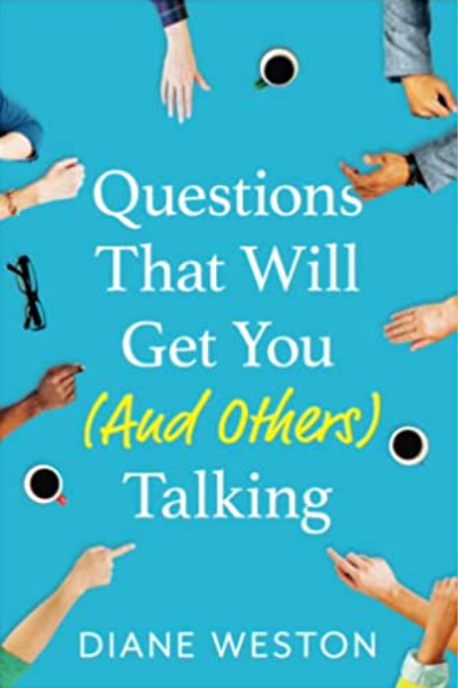
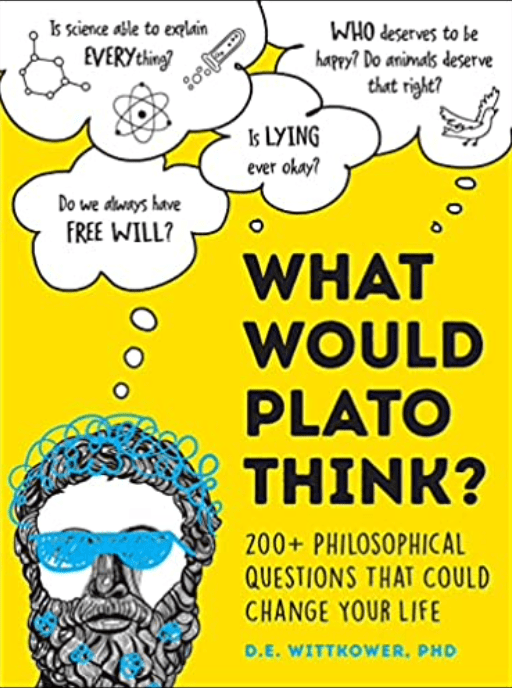
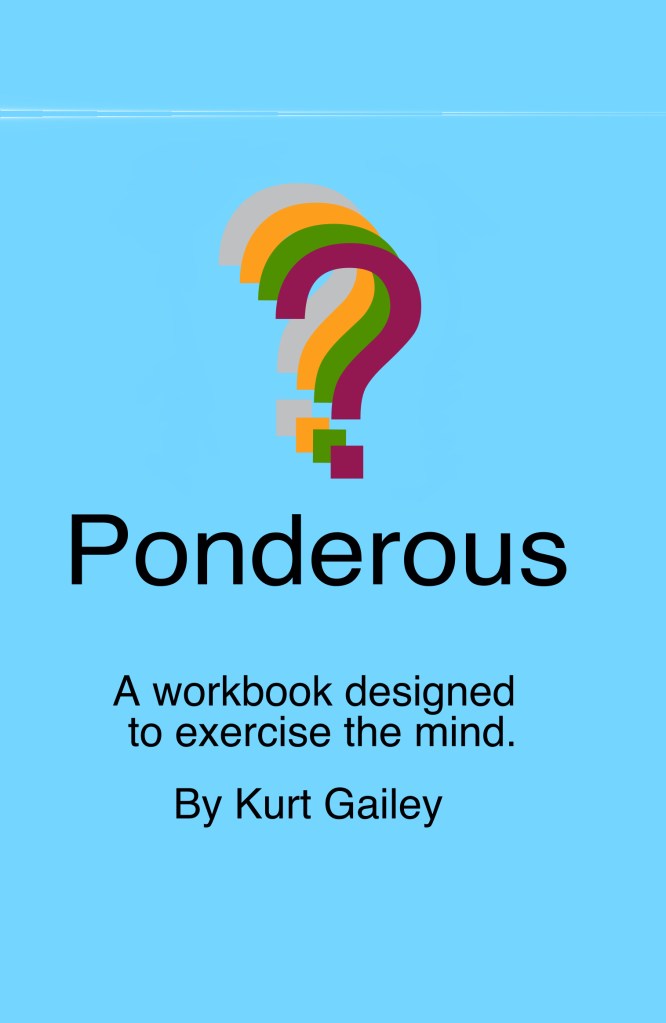
The three books I’ve chosen to compare are: Ponderous by Kurt Gailey (my own, of course); What Would Plato Think? by D.E. Wittkower, PhD; and Questions That Will Get You (And Others) Talking by Diane Weston.
Diane Weston has an impressive 1000+ questions in her book. Keep in mind though, these are what I would call pajama party questions. In the style of “What is your favorite color?”, pajama party questions are good for conversations. The way to tell if it’s a pajama party question is to look at the wording. Most questions with the word “you” within will be a getting-to-know-you type of question. Those kinds of questions won’t likely give you something to think about all day. If what you’re after is a way to boost creativity, or to ponder the deeper meanings of things, Weston’s book won’t be much help. Ponderous on the other hand has more profound material, such as: “Is Karma a method of blaming the victim?” If you want a way to get people to open up, to break the ice, to start connecting with each other, then her book will certainly give you the tools for those tasks. Her book, Questions That Will Get You (And Others) Talking is currently 11.99$ on Amazon, published by Monkey Publishing, and is 109 pages.
The book by D.E. Wittkower is probably more comparable, more similar, to Ponderous, even though he only has around 200 questions. One reason he has so few is because he leads in to every question, explaining the philosophies. This method could be good or bad. If you didn’t have any idea about the subjects Wittkower goes through, you might want to invest in his one-man explanations. If you didn’t want someone to lead you toward an answer, then you might rather invest in Ponderous and look up the subjects you don’t grasp already through more rounded and multi-person explanations, perhaps with Encyclopaedia Britannica or some other reliable source (never Wikipedia, which is built around submitter’s bias). The good Doctor has done his homework, and relies on studying ancient philosophers for the material. Ponderous, however, delves into the questions one could find while studying more contemporary philosophers like Theodore Sturgeon and Bruce Lee. Sturgeon in particular had the self-discipline to wonder, “What is the next question?” He probably understood when he first asked this that learning is dynamic, while knowledge is only static, which is why questions are so valuable. Lee for sure knows the difference between static and dynamic. He philosophizes throughout his great works on the two concepts in depth.
Presentation matters too, though. Wittkower does a good job with the presentation. Within the pages of his book, he leaves space for note-taking. He also tries to ask return questions for the more controversial questions so that he is playing both sides of the debate. His book may be somewhat narrow in scope since it only deals with subjects brought up by the ancients, but he formatted it well. His book What Would Plato Think? was published by Simon and Schuster, is 16.39$ on Amazon, and runs 225 pages.
Ponderous has 366 questions you can ruminate upon for an entire day, a week, during a meditation session, or during a pajama party if you must. The questions are a little more flexible. Some examples include:
“How many lies make a person a liar?”
“Can you get a tattoo on a prosthetic limb?”
“Why is ‘Question everything’ a statement?”
and
“How did anyone get angry before Heavy Metal music?”
These are existential questions, questions of life’s seeming contradictions, and questions to make the mind reel. There’s room inside Ponderous for taking notes, answering questions, or asking new ones. Independently published through Amazon, it is currently priced at seventeen dollars even, and is 379 pages long.
What exactly is Ponderous? It’s a self-help book with an eclectic array of life’s most interesting questions, such as:
Why is “Question everything” a statement?
And:
Is karma a method for blaming the victim?
And:
How did anyone get angry before Heavy Metal music?
These are not your average pajama party questions. Ponderous is not about getting to know someone’s favorite color; it’s about having something to ponder each day. With 366 questions contained in its pages, Ponderous is a leap year’s worth of valuable meditation, quality philosophy, or, yes, even questions you could bring to a party.
These are not intended to be questions which somehow lead you to answer “correctly”. These are questions which will lead you to better your skill at asking valid questions. Ponderous may lead you to ask even more. Why stop with the relatively small collection here? You may have your own existential questions. Start asking your own. Write them in the margins.
Ponderous is a journal-style workbook perfect for anyone who wants to know more about life, for those who meditate, for those who enjoy livening up a conversation, and for anyone who enjoys looking back at how they used to think and having a laugh.
Introspection can boost creativity, so Ponderous is ideal for anyone with artistic ambitions. Those who create anything artistic can benefit from a broadening of the mind through playful philosophy.
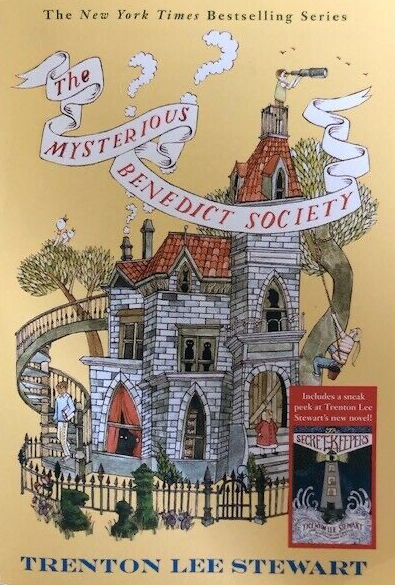
My family and I have thoroughly enjoyed the video series for Trenton Lee Stewart’s The Mysterious Benedict Society.
All the actors have done fine work portraying the characters. Tony Hale, most notably, has done a fantastic job playing the twins. He acts out a convincing slob as Nicholas, and a highly believable clean freak as Nathaniel. His parts as the twins are excellent, but wisely not too time-hoarding. The other characters and actors get a fair amount of time on the screen.
This paragraph (and from here on) contains spoilers—so if you haven’t read the books or seen the series, you may not want to read any more of this post. The latest offering of The Mysterious Benedict Society television series ends with a hilarious line from Nathaniel, who only recently had a change of heart from being the bad guy. He says, “We have a sister, and she’s not as nice as me.”
Great cliffhanger! Excellent use of new information as an element of suspense.
My worry here though, is that all the work to make the series great could be undone if Tony Hale plays the sister. He’s a talented actor, no doubt, and he’s great at acting different people, but they really should get a female to play the part of the sister. Sure it could be funny if the sister ends up looking just like the twins (facial hair and all?), but there wouldn’t be much tension between the characters if they’re all played by the same guy. It would make the whole thing too silly and novelty, you know? Like we’ve gone this far with quality characters and quality acting, and now it’s going to be just one guy playing the whole family? It would bring the series down to a level where it parodies itself, and that would lose my interest in a big hurry.
Regardless, and because, of my worry, I’m sure it’s evident that I’m invested in the show. They’ve done well to bring this series of books to a series of television shows. Hopefully it will continue in quality.




 Xenosthesia.com