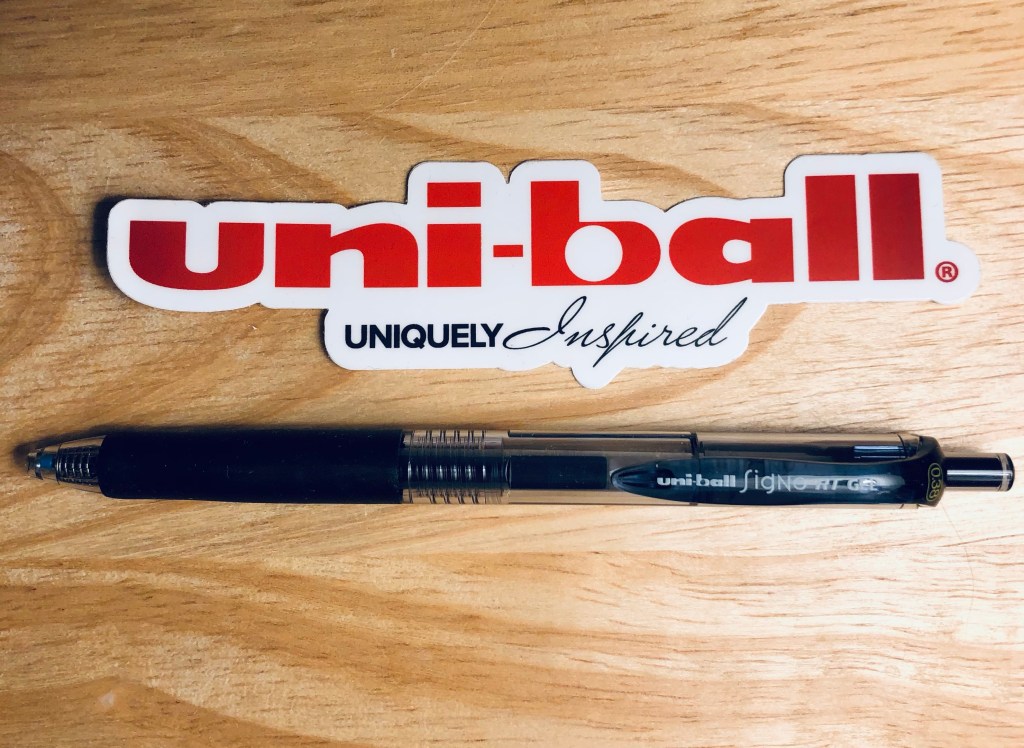
For the absolute best pens in the Uni-verse, you need to search no further than Uni-ball.
Whenever I’m writing anything in public, people gaze longingly at my fine writing instrument. Whenever I loan my pen to someone so they can write, they always say, “Ooh, this is a great pen. What kind is it?”
Of course, I tell them, “It’s a Uni-ball!”
No one can resist the allure of a Uni-ball.
Now you might be wondering where you can find such an excellent writing instrument. Many office supply stores carry the Uni-ball brand. However, I’ve recently noticed the stores near me don’t stock my favorites: the Uni-ball Signo RT Gel Ultra Micro 0.38. A quick search of Uni-ball’s web site and they do indeed still make them. Why don’t the stores carry these amazing pens when they carry many other Uni-ball products? I haven’t asked yet. But I will.
Regardless of the reason for not stocking the best of the best, I really enjoyed browsing the Uni-ball site. You’re sure to enjoy it too. Who knows, you might find your favorite style of Uni-ball pen there as well.
They are loved and hated, adored and avoided, treasured and spurned. Not at all unlike rap music and country music. People tend to either love or hate. It’s rare to get anyone on the fence about them.
Here’s a new way to see it: Romance novels are necessary.
Though it’s probably rare to find boys reading anything from the Romance shelves, boys are the ones who need it the most. They need to learn about the ‘birds and the bees’.
In a world full of absentee fathers, where else will a boy learn what he needs to know about girls? Hopefully not from that absentee father. And if the boy doesn’t learn about it from anyone, he’ll still learn something from that absentee father. He’ll learn to emulate. He might begin to think it’s just what men do: make babies and run.
Well, but then couldn’t it be argued that’s a message published by the Romance style of books? It’s a definite possibility. My personal experience with romance novels is not broad. I tried to read Nabokov not too long ago, and it made me have the dry heaves. Regardless of my aversion to the story Lolita, I did learn. I learned something about the psychology of a pedophile. And I also learned more than one thing about writing. How to write well, and how to write poorly.
Aside from those things, reading Lolita didn’t make me want to read more so-called Romance books. This article, however, is not about Nabokov. It’s about how necessary romance is in fiction. And how dudes need to read more. Dudes don’t often get themselves educated. They don’t often read, or even be found reading. Which is why they use the word ‘dude’ a lot—even when talking about females.
Terribly non-romantic. How many guys who walk around calling the females in their lives ‘dude’ are learning how to treat a lady with respect? A few maybe, but they’re the exceptions. And I bet the exceptions grow mature enough (eventually) to differentiate between male and female and then (eventually) stop calling everyone dude all the time.
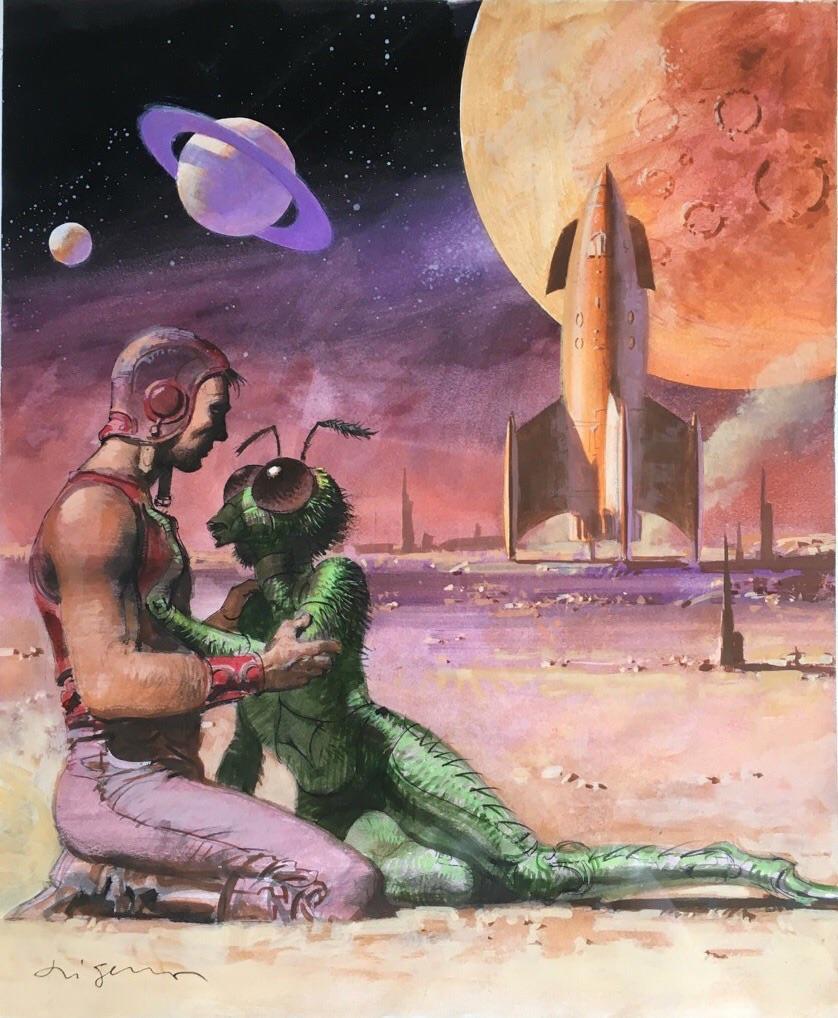
To rectify the lack of dudes reading Romance, I think we need to branch that tired old genre out. It needs more links to sci-fi and horror and motorcycle maintenance. Or we could flip that idea right on its head and say all of these categories need to be linked to Romance.
It’s a long shot, I know. What are the chances that the trend of cowardly runaway fathers will decrease if we make romantic space operas? Or romantic horror-fests? Would it actually get men reading? Would it actually make them more honorable or loyal?
Be mostly stupid. Comedy doesn’t require you to think scientifically, or mathematically, or philosophically, or logically. You can let your intellect blow away on the breeze, if you like. Or you can let it slip down into your crotch, into your underclothes (front or back, it doesn’t really matter), and then use the groin area for much of your thinking.
Hyperbole greased over by exaggeration and enflamed with excessive lies. Tell lies at every turn. Life isn’t interesting enough for the comedy scene, so spice it up! Make the story funny by adding flavor on the flavor. Never settle for mediocre anything. If the main character is about to die, say they died, not only once, but twice. Let them be eaten by the wild animal, run over by speeding traffic, burned by massive mixtures of chemicals, infested with alien eggs, shocked by putting both hands in the toaster, and consumed by a super colony of angry red ants.
Wax political. Naturally, if you combine the first two ingredients for comedy, stupidity and hyperbole, you come up with a cauldron full of politics. Stir it together and create a magical monstrosity.
Make comparisons of anything and everything. Not everything has an opposite, but everything can be compared to everything else. Because of this, comparisons are limitless, boundless, endless, not to mention, infinite. For instance, if you needed a punchline about nachos, let everyone ponder over how they’re so similar to fingers, wait the appropriate amount of time, then tell them how both go crunch when put them in a vice. Which brings us to our next requirement:
Timing. It should be obvious to not start with the punchline, and it should be obvious to not give the punchline immediately after the lead-in. Let the audience stew over what you tell them. Make them guess a little. They may even come up with something clever and creative you hadn’t thought of yet. Along the same lines, some details should be given in rapid-fire fashion. Pace is part of timing, as much as correlation is. Pacing is not the art of walking across a stage then back again, but the art of sending the audience on a ride at the speed necessary—sometimes that speed is haltingly slow, other times it’s breakneck. Correlation means mixing topics. The art of correlation can be spectacular or disastrous. Having two jokes too close together can create a third mixed image in the audience’s minds. Say you talked or wrote about underwear in one instance and then about flavors and spices in the next. The reader or listener could potentially come away from that with a bizarre image of cooking in underwear. This is good or bad, depending on your intentions. Were you going for the gross-out? Or did you accidentally make your audience sick?
Then, there’s the art of the obscene. Too many fart jokes will establish you as an amateur. Too many gross-outs will most likely turn people away. They’ll begin to avoid your brand of entertainment. Once they know what you’re about, they’ll print a mental category on you, and likely it’s where you’ll stay.
You might be wondering, “What’s the big deal about the lunar new year, anyway?”
Some cultures in the world base the calendar year off of the phases and cycles of the moon. Months in a lunar calendar are still twelve in number, though they tend to be shorter than months in other calendars. A lunar cycle is 27 days, so a lunar month is about 27 days, depending on the culture. This shortness of months tends to drift the year. After using a calendar with lunar months, an adjustment has to be made so the calendar doesn’t slip from one end of the seasonal year to the other. In other words, lunar calendars sometimes have 13 months.
You may have heard of the ox as well. “Why is this the year of the ox?”
For some cultures the year isn’t only based on the phases of the moon, the astrology is also. China and its people, for example, use a zodiac with the following symbolic characters.
Rat
Ox
Tiger
Rabbit
Dragon
Snake
Horse
Sheep
Monkey
Rooster
Dog
Pig
Their zodiac uses these symbols on a yearly basis. More specifically, an entire year will be assigned one of the animals in the zodiac. The year 2021 (on the Julian calendar) is a year of the ox. The previous year was the year of the rat. For those interested in the entertainment of astrological predictions, remember your astrological sign is for the entire lunar year you were born. If a baby is born before 12 February 2021, then that baby is assigned the symbolic character of the rat. After 12 February 2021 (and before 1 February 2022), the baby would be given the sign of the ox.
Aside from the astrology of another calendar, the big deal about a lunar new year is the celebration of differing cultures. You can look at the way other people divide the days, the way they celebrate life, and how they generate their own ideas.
Plus, who among us would turn down a reason to celebrate the new year twice?
In an effort to find the magical and memorable things to do for Valentine’s Day, people turn to polling each other, striking up conversations at work, and even graffiti on public transit (strange but true).
If you’re looking for some ideas of what to do, and what not to do, for a Valentine’s Day event, there’s no need to look beyond this article. If these ideas don’t spark your interest, they may still spark your creativity.
Below are compiled the best ideas and the worst ideas. Peruse and choose.



 Xenosthesia.com